
Author
Team Further with Kids
This article may contain affiliate links. We may earn a commission at no extra cost to you. Please read our Disclaimer for more information.
Wondering how to get around South Korea with kids? On our family trip, we combined trains for longer journeys with taxis for local transfers. This guide covers travel between Seoul, Andong, Gyeongju and Busan, alongside public transport, airport transfers, rental cars and the apps we found useful. We also explain when a private transfer is worth considering, especially for countryside accommodation and journeys with luggage.
One thing we found almost essential was having reliable mobile internet. We constantly needed it to navigate with Naver Map, book taxis, translate addresses, find restaurants or cafés nearby and check whether we still had time for another activity.
This guide covers transport along our family travel route through Seoul → Andong → Gyeongju → Busan → Seoul, including trains, buses, taxis and private transfers. For the complete sightseeing route and day-by-day plans, explore our 14-Day South Korea Itinerary with Kids.
Table of Contents
How to Get Around South Korea: Transport Options at a Glance
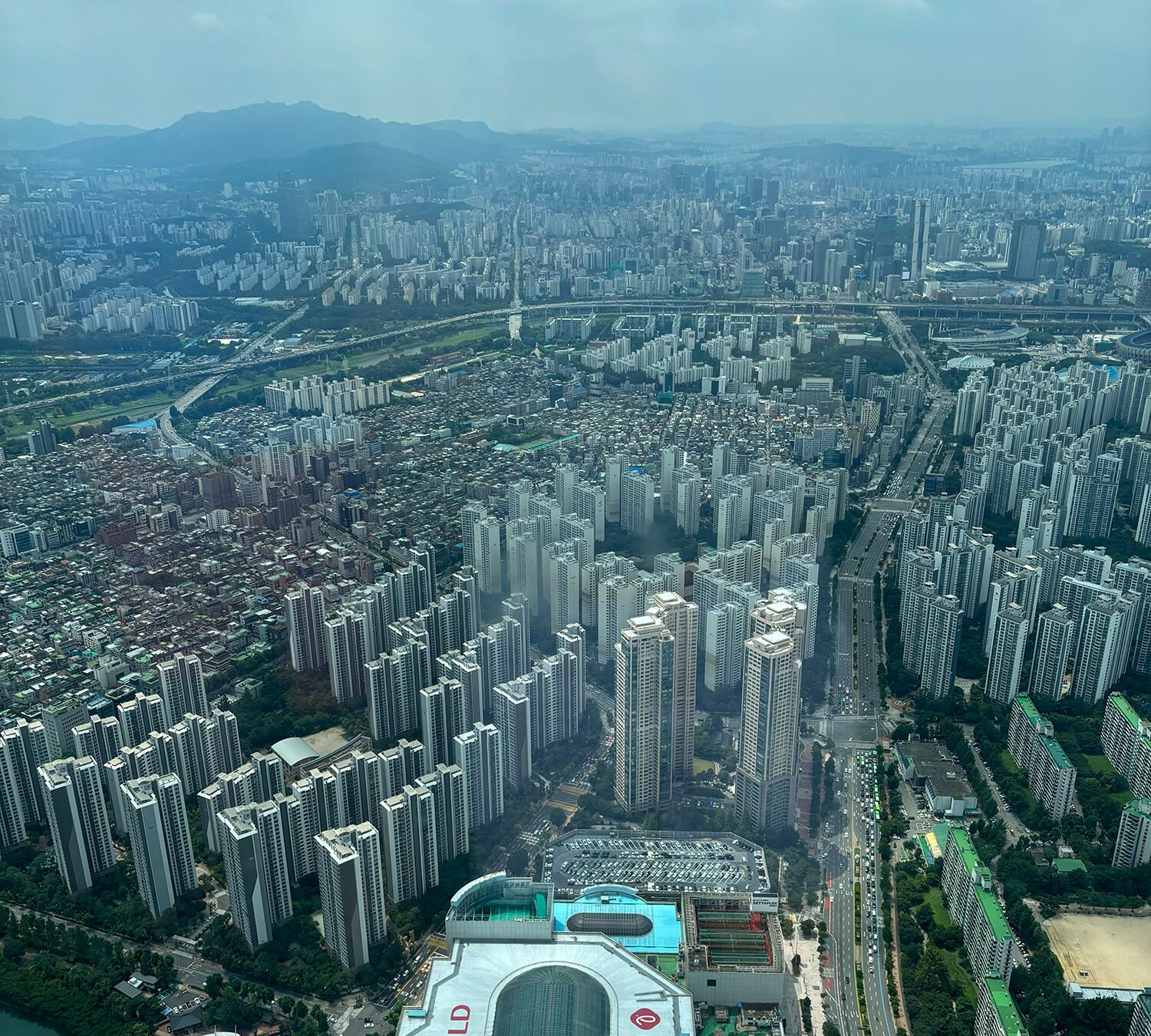
Panoramic views over Seoul’s skyline from the Seoul Sky Observatory at Lotte World Tower, South Korea.
You don’t need to arrange every journey before departure, but organising a few essentials can make travelling around South Korea much easier. We recommend starting with airport transfers, mobile internet and your main intercity journeys.
Click on any transport category below to jump to our detailed tips, or use the booking links to explore your options.
| What to arrange | Our recommendation | Booking or information |
|---|---|---|
| Airport transfer | Compare airport trains, buses and private transfers for a comfortable arrival | Compare Airport Transfers with Kiwitaxi→ |
| Mobile internet & eSIM | Set up reliable mobile internet before departure | Compare South Korea eSIMs on Airalo→ |
| Essential travel apps | Download Naver Map, Uber, Kakao T, Papago and Emergency Ready | Download the apps before travelling |
| KTX & other trains | Compare routes, timetables and train tickets for longer journeys | Explore Train Tickets on Klook→ |
| Private intercity transfers | Consider door-to-door transport between Seoul, Andong, Gyeongju and Busan | Book a Private Transfer → |
| Local transport & taxis | Combine subways, buses and taxis depending on distance and convenience | Uber / Kakao T / k.ride |
| Sightseeing passes | Save on admission to selected attractions in Seoul and Busan | Discover Seoul Pass → / VISIT BUSAN PASS → |
| Rental cars | Useful for exploring countryside destinations independently | Compare Rental Cars with QEEQ → |
| Guided tours & private drivers | Explore several attractions in one day without arranging separate taxis, transfers or transport between stops | Explore South Korea Tours on Klook→ |
1. Arriving in South Korea: Airport Transfers
After a long flight, getting from the airport to your accommodation is probably the first transport decision you’ll face.
South Korea has excellent airport connections, but the best option depends on your arrival time, luggage, hotel location and how tired everyone is after travelling.
Incheon International Airport to Seoul
Most international visitors arrive at Incheon International Airport (ICN), which is outside central Seoul.
There are several ways to reach the city.
Airport Railroad Express (AREX)
The AREX connects Incheon Airport with Seoul Station. The express service is a convenient option if your accommodation is near Seoul Station or you can easily continue by subway or taxi.
However, remember that reaching Seoul Station doesn’t necessarily mean you’ve reached your hotel. With children and luggage, the final transfer can make a difference.
Airport limousine buses
Airport buses serve different areas of Seoul and can be convenient if there’s a stop close to your hotel.
We recommend checking the exact stop location before choosing this option, especially if you have several suitcases.
Private airport transfers
A prebooked private transfer is worth considering if you want to travel directly from the airport to your hotel without changing transport.
It can be particularly comfortable after a long international flight, especially when travelling with younger children or several pieces of luggage.
Our Tip: When booking a private transfer, provide your flight number, arrival terminal, number of passengers and amount of luggage. Check the vehicle size, meeting instructions and waiting-time policy before confirming.
Other Airports to Know
Gimpo International Airport (GMP) is closer to central Seoul and serves many domestic flights.
Gimhae International Airport (PUS) serves Busan.
Always check the airport code on your flight ticket. Incheon and Gimpo are different airports, and travelling to the wrong one could cause a serious problem on departure day.
2. Mobile Internet in South Korea: eSIMs and Other Options
For us, having good mobile internet while exploring South Korea was one of the most important practical parts of the trip.
We regularly needed internet access to:
- Navigate through unfamiliar streets with Naver Map.
- Use Google Maps to explore nearby places, discover attractions and save locations we wanted to visit.
- Book taxis using Uber or other taxi apps.
- Find nearby restaurants, cafés and attractions.
- Check public transport routes and travel times.
- Translate Korean addresses, signs and menus.
- Decide whether we had enough time to fit in another activity.
Without mobile internet, many of these everyday decisions would have been considerably more difficult.
Why We Recommend an eSIM
If your phone supports eSIM technology, purchasing a data package before departure is one of the easiest ways to organise mobile internet.
You can choose a suitable plan, install it before travelling and follow the provider’s activation instructions when you arrive.
An eSIM also means you don’t have to spend time buying a physical SIM card at the airport.
We recommend comparing the amount of data, validity period and total price before choosing a package.
Our Tip: We recommend having mobile internet access on more than one adult’s phone, so you always have a backup if one connection stops working or a phone runs out of battery. It’s also a good idea to save important addresses and reservations offline and check your home SIM’s roaming settings to avoid unexpected charges.
3. Essential South Korea Travel Apps: Maps, Taxis and Translation
Having the right apps installed before arriving in South Korea makes travelling around the country much easier.
These are the applications we found useful or recommend preparing before your trip.
| App | What we would use it for | Important tip |
|---|---|---|
| Naver Map | Walking directions, public transport, restaurant searches, opening hours and navigation | Our preferred app for navigating in South Korea |
| Google Maps | Planning an itinerary and saving attractions before departure | Useful for planning, but we preferred Naver Map for actual directions |
| Uber | Booking taxis in South Korean cities | Worked well during our trip and was convenient to use |
| k.ride | Booking taxis with visitor-friendly features | Another option worth having available |
| Kakao T | Booking local taxis | A useful additional taxi-booking option |
| Papago | Translating Korean text, menus and conversations | Particularly useful when English translations aren’t available |
| Emergency Ready App | We received frequent alerts during our trip, sometimes in Korean. | We received useful alerts through the app during our trip |
Taxi Apps in Korea: Uber, Kakao T and k.ride
Our experience with maps: Google Maps was useful for preparing our itinerary and marking everything we wanted to visit. But when we tried to navigate, it sometimes placed destinations incorrectly.
We used Naver Map for actual directions, including walking routes, public transport and finding nearby restaurants.
Always save your hotel’s name and full address in Korean, as taxi drivers may not understand or recognise addresses written in English. Having the Korean address ready to copy into a taxi app or show directly to the driver can make getting around much easier.
Emergency Ready: An App Worth Downloading
We also recommend downloading Emergency Ready, South Korea’s official emergency information app for foreign visitors.
It provides safety information and emergency alerts, including notifications about severe weather, natural disasters and other potential hazards.
During our trip, we received quite a lot of emergency alerts through the app. Although the notifications were often in Korean, we recommend taking a moment to translate and check them, as they may contain important safety information relevant to your location.
Our Tip: Download the app before departure, enable notifications and check the available language settings so you don’t miss important safety information.
4. Travelling Between Cities in South Korea: Trains and Private Transfers
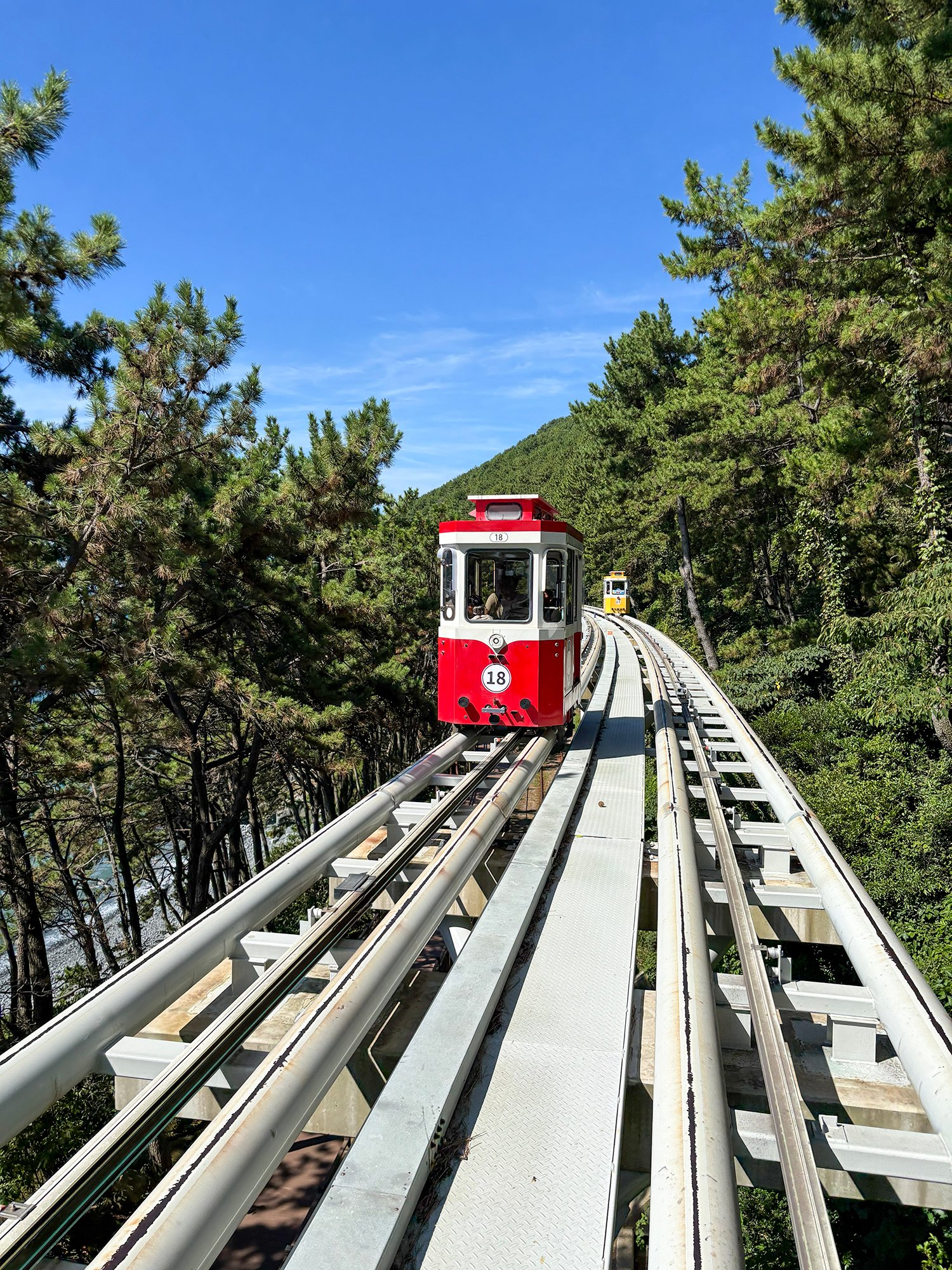
Riding the colourful Sky Capsule along Busan’s scenic coastline, with beautiful views of the sea.
South Korea has an efficient railway network, making trains a convenient way to travel between major destinations.
However, not every place you’ll want to visit is close to a railway station.
This is particularly important when travelling to Andong and Gyeongju, where some of the most memorable places to stay and attractions are located outside the city centres.
For families, we recommend comparing the complete journey from one hotel to the next rather than looking only at train times.
Our South Korea Route: Which Transport Makes Sense?
| Journey | Recommended option | Alternative |
|---|---|---|
| Seoul → Andong | KTX-Eum train and local taxi | Prebooked private transfer |
| Andong → Hahoe → Gyeongju | Prearranged taxi or private transfer | Public transport with additional connections |
| Gyeongju → Busan | Train or private transfer | Intercity bus |
| Busan → Seoul | KTX high-speed train | SRT or intercity bus |
Seoul to Andong
Travelling from Seoul to Andong by train is a comfortable option.
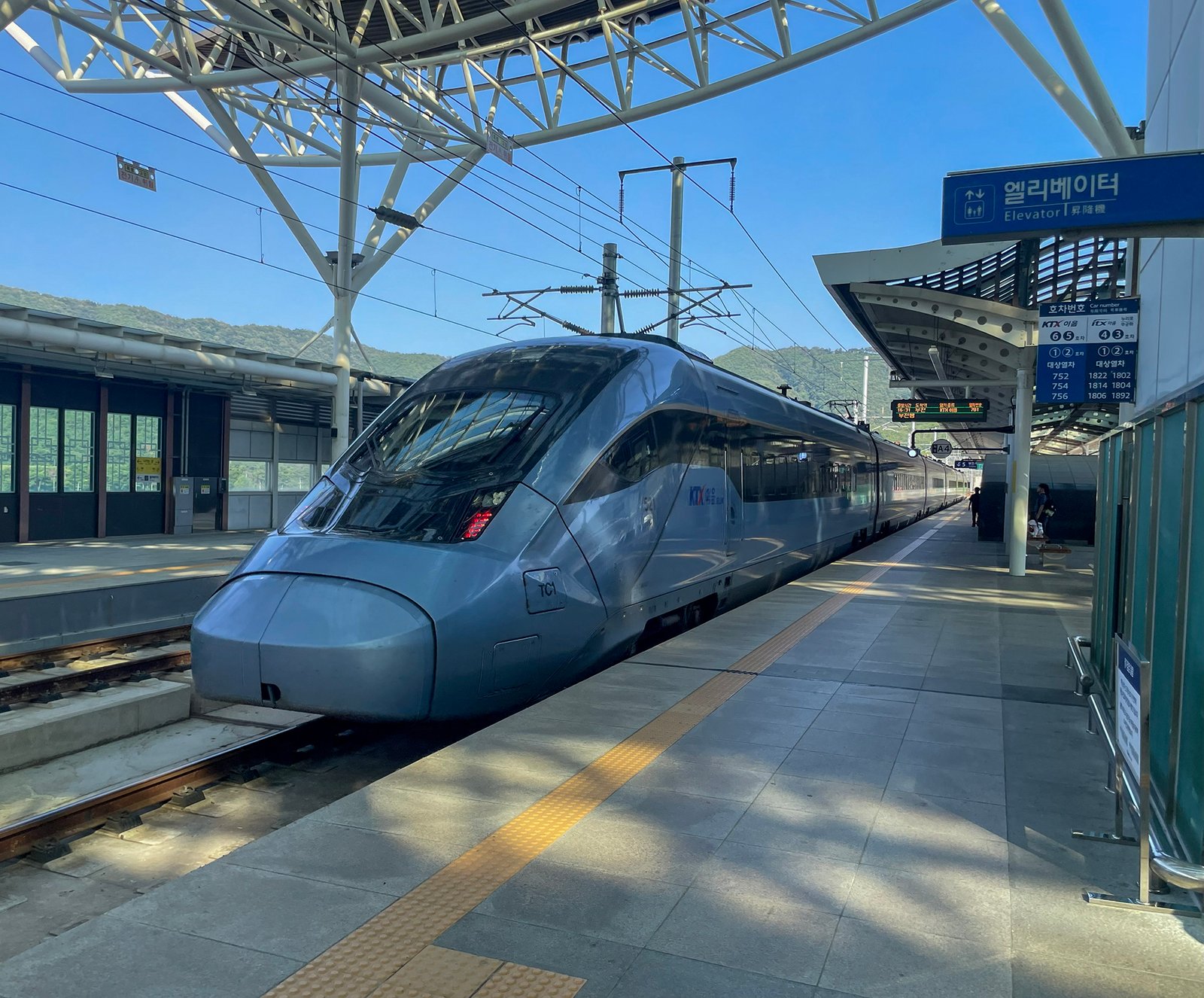
The KTX-Eum connects Seoul’s Cheongnyangni Station with Andong, making it possible to travel without renting a car.
However, Cheongnyangni is not the same as Seoul Station, so check the departure station carefully when planning your journey.
Once you arrive in Andong, you’ll probably need additional transport if you’re staying in a countryside hanok.
For example, accommodation near Bongjeongsa Temple or Hahoe Folk Village can be some distance from the railway station.
A private transfer from Seoul directly to your accommodation is another option worth comparing, especially when travelling with luggage.
Andong to Gyeongju
This is one of the journeys where we particularly recommend considering a taxi, a prearranged long-distance taxi or a private transfer.
Public transport is possible, but reaching a countryside hanok, visiting attractions and continuing to Gyeongju can involve several connections.
Taking a taxi can also be a convenient option, especially if you prefer travelling directly between accommodations without changing transport. However, for longer journeys, it’s best to confirm in advance that the driver is willing to travel to your destination and agree on the fare.
If you want to visit Hahoe Folk Village along the way, arranging a taxi or private driver for several hours may offer more flexibility.
Keep in mind that sightseeing stops are not automatically included in a transfer. Confirm the route, waiting time, luggage arrangements and total price before booking.
Gyeongju to Busan
Gyeongju and Busan are relatively close, so several transport options are worth comparing.
Travelling by train can be efficient, but remember that Gyeongju Station is outside the main historic centre.
You’ll need to account for the journey from your accommodation to the station and from the arrival station in Busan to your hotel.
For families staying in a countryside hanok, a private transfer directly to a hotel in Busan can be particularly convenient.
Busan to Seoul
For this journey, we recommend travelling by KTX high-speed train.
It’s a comfortable way to cover the longer distance between Busan and Seoul, and everyone can relax during the journey.
KTX services between Busan and Seoul generally take around two and a half to three hours, depending on the train.
Check the exact arrival station before booking. KTX services can arrive at Seoul Station, while SRT services use Suseo Station, which may be less convenient depending on your accommodation.
How to Buy Train Tickets in Korea with Children
We recommend checking train schedules and booking seats together once your travel dates are fixed, particularly during weekends and Korean public holidays.
Before booking, check:
- The correct departure and arrival stations.
- Whether seats are together.
- Children’s ticket prices and age categories.
- Luggage arrangements.
- Cancellation and ticket-change conditions.
You can also check current timetables and ticket options through the official Korail website.
Not every route or service is necessarily available through third-party booking platforms.
Private Transfers Between Cities
Private transfers can be an excellent alternative to trains when travelling with children, particularly if your accommodation is far from a station.
Door-to-door transport can save the effort of carrying luggage through stations and arranging additional taxis at both ends.
For a family of four, it’s worth comparing the total cost of train tickets and local taxis with the price of a private transfer.
Our Tip: When requesting a quote, include the full addresses of both accommodations, the number of passengers, children’s ages and luggage. Confirm whether tolls, waiting time and additional sightseeing stops are included.
5. Getting Around Seoul, Busan and Other Cities
For exploring cities, we recommend combining public transport, walking and taxis.
South Korea’s subway systems are efficient, but travelling with children sometimes makes a taxi the more comfortable option.
Public Transport in South Korea: Subways and Buses
Seoul has an extensive subway network connecting many of the city’s main attractions.
For sightseeing, we recommend grouping nearby places together rather than travelling back and forth across the city.
In Busan, distances between attractions can be considerable. Areas such as Haeundae, Gamcheon Culture Village and Yeongdo are best planned with travel times in mind.
Buses can also be useful, especially where subway connections are less convenient.
T-money Cards for Families: Buying, Topping Up and Child Fares
A T-money card is a rechargeable transport card that makes getting around South Korea easier. Use it for participating local buses and subways, including journeys in Seoul and Busan. It is a pay-as-you-go card, not an unlimited travel pass.
Where to buy a card
You can buy T-money cards at participating convenience stores such as CU, GS25 and 7-Eleven, including outlets at airports. They are also available at designated subway sales points. The card itself and the travel balance are paid for separately.
How to top up — bring Korean won cash
Recharge your card at participating convenience stores or subway top-up machines. At a shop, hand over your card and ask staff to add your chosen amount; at a machine, follow the on-screen instructions.
Carry Korean won cash for topping up a standard physical T-money card. Do not assume that your foreign bank card will work for this. Mobile products and other transport passes can have different payment options.
Children’s and teenagers’ discounts
In Seoul, child fares generally apply to ages 6–12, and youth fares to ages 13–18. To receive the appropriate discount, ask the convenience-store staff to register your child’s date of birth on their card before the first journey. Have their passport available as proof of age. Simply buying a card does not automatically activate the discount.
Does everyone need their own card?
For straightforward family travel, give each fare-paying traveller their own card, including children. Subway passengers need individual cards or tickets to pass through the gates. Keeping separate cards also makes it easier to manage different fare categories.
Where to tap
On the subway, tap your card at the gate when entering and when leaving. On buses, tap when boarding and again before getting off. Use the same card throughout your journey so the system can calculate the fare and any eligible transfer discount correctly.
Our Tip: Mark the children’s cards so everyone keeps the correct one, and check balances before a busy sightseeing day. T-money does not replace a separately booked KTX ticket.
Sightseeing Passes: Discover Seoul Pass & VISIT BUSAN PASS
Unlike the T-money card, which is primarily used to pay for public transport, sightseeing passes give visitors access to selected attractions and experiences. Some passes also offer additional transport benefits, depending on the package.
If you’re planning to visit several paid attractions in Seoul or Busan, it’s worth checking whether a city sightseeing pass could save your family money.
Discover Seoul Pass
The Discover Seoul Pass offers access to a selection of popular attractions and experiences in Seoul, with different pass options available.
Depending on the package you choose, you may be able to visit attractions such as Lotte World, N Seoul Tower or SEA LIFE COEX Aquarium, while certain passes may also offer additional transport benefits or discounts.
Not every attraction is included in every pass, so check the specific package and its list of participating attractions before booking.
Visit Busan Pass
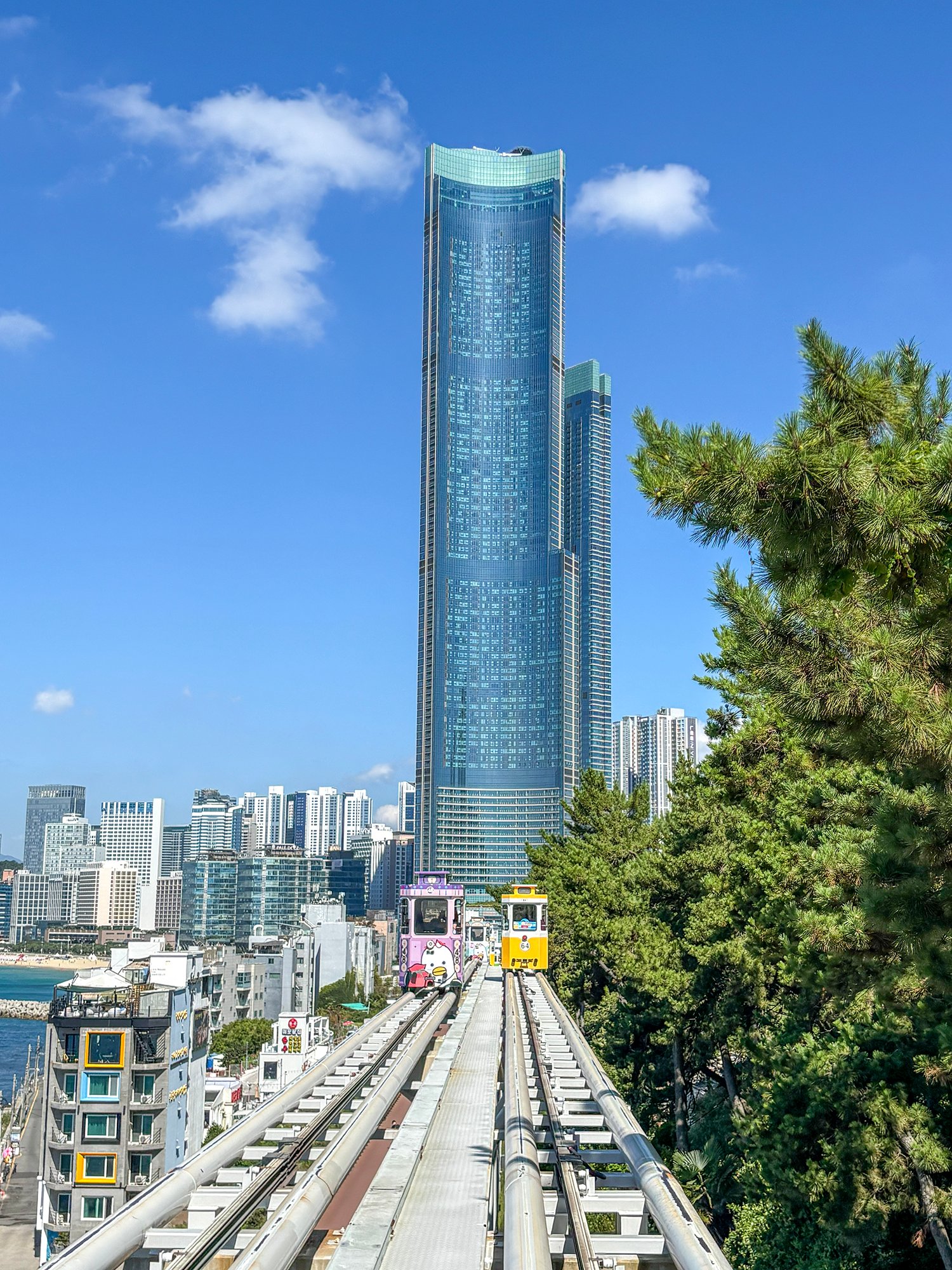
Spectacular panoramic views of Busan’s coastline and skyline from BUSAN X the SKY Observatory.
The VISIT BUSAN PASS can be a convenient way to explore several attractions in Busan without purchasing every admission ticket separately.
Depending on the pass type and current participating attractions, it may include experiences such as Busan X the Sky, Songdo Marine Cable Car and Haeundae Beach Train.
Different pass options are available, including time-based and attraction-based packages. The physical card can also function as a rechargeable public transport card, with transport fares paid separately.
Our Tip: Before purchasing either pass, make a list of the attractions you actually want to visit and compare the individual ticket prices with the cost of the pass. Check exactly which attractions are included in your chosen package, along with reservation requirements and validity periods. When travelling with children, we wouldn’t recommend rushing between attractions just to make a pass worthwhile.
When We Would Choose a Taxi
We found taxis particularly useful when they saved time or made a busy sightseeing day more manageable.
Sometimes a taxi between two attractions meant we could spend more time exploring instead of navigating several subway changes.
For a family travelling together, it’s worth comparing the total public transport cost with a taxi fare.
However, during heavy traffic, the subway may be faster.
Our Tip: Always check the vehicle size if you’re travelling with luggage. A standard taxi may not accommodate four passengers and several large suitcases.
6. Renting a Car in South Korea
Can You Travel Around South Korea Without a Car?
Yes. Trains, buses and taxis make it possible to travel around South Korea without renting a car, including routes between Seoul, Andong, Gyeongju and Busan. Countryside accommodation and attractions outside city centres need more careful planning. Compare the full journey, including station transfers, luggage and waiting time, and consider a private transfer or driver where public transport connections are inconvenient.
Renting a car can be useful when exploring rural areas, particularly if you want to visit several attractions in one day.
However, we wouldn’t recommend renting a car simply for sightseeing in central Seoul.
Public transport and taxis are generally more convenient there, and parking can add unnecessary complications.
Where a Rental Car Makes Sense
A rental car may be worth considering for:
- Exploring the countryside around Andong.
- Visiting attractions outside Gyeongju’s historic centre.
- Staying in rural accommodation far from public transport.
- Travelling independently between smaller destinations.
It can offer flexibility, especially when travelling with children and luggage.
International Driving Permit: An Important Requirement
If you’re planning to rent a car in South Korea, check the driving-document requirements well before departure.
Foreign visitors generally need a valid national driving licence together with an International Driving Permit (IDP) recognised in South Korea, subject to the applicable rules.
An ordinary driving licence alone may not be sufficient.
We experienced how important this is: without the required International Driving Permit, collecting a rental car may not be possible.
Make sure you obtain the correct documents before leaving home rather than assuming you can arrange everything after arrival.
What to Check Before Renting
Before booking a rental car, confirm the following:
- Whether your driving licence and IDP are accepted.
- The number of passengers and luggage capacity.
- Child-seat availability and requirements.
- Insurance coverage and excess.
- Toll roads, parking and fuel policies.
- Pickup and return locations.
7. An Alternative: Guided Tours and Private Drivers
Guided tours can be one of the easiest ways to explore South Korea with kids, especially when visiting attractions outside the major cities.
One of their biggest advantages is that you don’t have to organise separate taxis, transfers or public transport connections between attractions. Instead of figuring out how to get from one place to another, you can simply enjoy the day with your family.
Many organised day trips combine several attractions into one itinerary, often with transport between stops included. This can be particularly convenient when visiting countryside destinations, where public transport may be limited or involve several connections.
Guided tours are also a good alternative to renting a car if you don’t want to drive in an unfamiliar country.
Our Tip: Before booking, check whether hotel pickup and drop-off are included, where the tour starts, how much free time you have at each attraction and whether entrance tickets are covered. Some tours include transport only from a designated meeting point.
Getting Around South Korea: Our Final Family Travel Tips
The most important thing we learned was that you don’t need to rely on one type of transport throughout your trip.
Trains are excellent for many longer journeys, taxis can make city sightseeing more comfortable, and private transfers are worth considering for countryside accommodation and more complicated connections.
We strongly recommend organising mobile internet before departure and downloading your essential navigation and taxi apps in advance. Reliable internet access makes it much easier to navigate with Naver Map, arrange taxis and adjust your plans while travelling.
When planning how to get around South Korea with kids, choose your transport based on your route, luggage and accommodation rather than relying on a single option.
For our complete sightseeing route, follow our 14-Day South Korea Itinerary with Kids.
If you’re planning the journey between Seoul, Andong, Gyeongju and Busan, our Gyeongju 2-Day Itinerary with Kids includes practical transport recommendations, KTX booking options, private transfers and guided day tours from Busan.